Thought Leadership · 2026
Identity Verification Was Built for Humans. Agentic Commerce Changes the Equation
By Ezekiel Dada — Identity Verification & Fraud Prevention Writer
For years, digital identity verification has revolved around a simple question: Who is the person on the other side of this transaction?
That question has produced an entire industry of liveness detection, document authentication, behavioral analysis, and step-up verification.
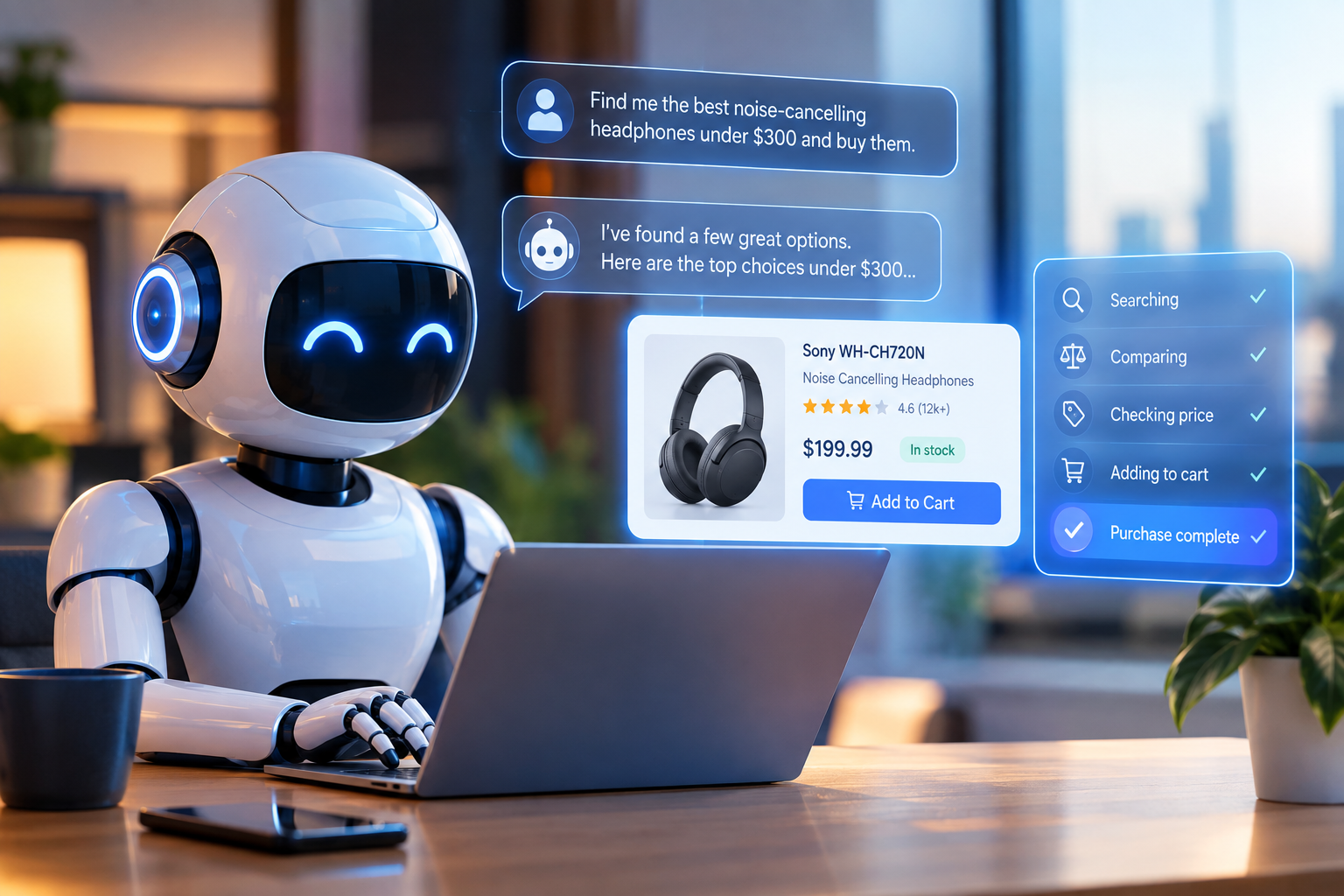
Now, AI has been on what seems to be an unstoppable rise. AI shopping agents now browse merchant catalogs, compare prices, hold payment credentials, and submit checkout requests entirely on behalf of humans who may not be present.
What happens when a sophisticated AI agent is the one making the transaction?
From the merchant’s POV, the customer is a human. Whereas the entity interacting with the merchant is software.
That creates a problem traditional identity verification was never built to answer: How does a business know if an agent is doing the transaction and who authorized it?
The industry has recognized the gap.
Has it closed it? Not yet.
Why This Isn’t Hypothetical Anymore
It would have been easy to treat this as a future problem. You know… something to plan for once agentic commerce matures. But it isn’t.
Security researchers at Palo Alto Networks’ Unit 42 have already identified fraud tooling built specifically to exploit agentic shopping flows, including the possibility of scammers liquidating a retailer’s cash reserves before a human even walks into the office.
The friction is showing on the legitimate side too. Visa says that agent-initiated transactions are evaluated using existing fraud signals alongside additional context, like behavioral patterns, device-level risk identifiers, and deviation from expected activity. This creates two problems. First, a legitimate agent can be flagged as a bot and blocked. Second, a malicious actor can try to make automated activity look legitimate.
The Industry’s Early Answers and Their Limits
Several frontliners of the industry have been working behind the scenes, and efforts are underway to close the gap.
Visa Trusted Agent Protocol
This protocol is designed to help merchants recognize AI agents through cryptographically signed messages. It can provide information about the agent, the consumer it is acting for, and payment credentials.
Mastercard Agent Pay
This is a commerce tokenization program built around trusted agent participation in payments. It layers AI agents on top of existing EMV tokenization, giving networks a way to recognize an authorized agent rather than treating every agent transaction as irregular.
Google’s Universal Commerce Protocol
This protocol was unveiled at NRF’s Big Show in January 2026. It takes a broader commerce-infrastructure approach, connecting consumer surfaces, businesses, and payment providers for agentic commerce.
These three developments show that the industry is building mechanisms to address AI agent identity issues, but that doesn’t mean the problem is fully solved—especially with the unpredictable advancements of AI.
A June 2026 Fortune report on a Brainstorm Tech panel captured the most pressing uncertainty: the liability for actions taken by AI shopping agents.
Is “Know Your Agent” (KYA) the Answer?
KYA is emerging as a parallel concept to KYC. It’s a way to fix the trust relationship around AI agents, evaluate an agent’s identity, its reputation score, and behavior over time.
It has to answer the following questions:
Identity: Who is the agent?
This is where cryptographic signatures, credentials, attestations, and other machine-verifiable identity mechanisms become important.
Visa’s protocol, for example, uses signed requests that merchants can verify against trusted public keys. The signature is intended to provide cryptographic assurance that the request came from a trusted agent and has not been altered or replayed
Authorization: What is the agent allowed to do?
Agentic systems need mechanisms for defining and enforcing boundaries such as:
- Spending limits
- Approved merchants
- Product categories
- Transaction frequency
- Geographic restrictions
- Expiration of authorization
- Specific purchase instructions
Mastercard’s Agent Pay, for example, explicitly describes permissioning and spending limits as part of its approach to machine-driven transactions.
Accountability: Who is responsible when something goes wrong?
This may be the hardest question.
Imagine an agent has valid credentials but is manipulated through an attack. Who will be held responsible?
The developer?
The company operating it?
The merchant?
Or the payment provider?
What Businesses Should Do Now
You don’t need to wait for agentic commerce to become completely standardized before thinking about the problem.
Start doing this instead:
Stop Treating All Automated Traffic as the Same
A legitimate agent, a search crawler, and a malicious scraper may all generate automated requests. They should not necessarily receive the same treatment.
Security infrastructure needs to distinguish between different types of automated actors rather than assuming automation itself is suspicious.
Start Looking for Verifiable Agent Identity
If an agent is going to interact with your systems, ask what evidence it can provide about who it is.
Cryptographic signatures and other verifiable credentials can provide stronger assurance than relying solely on IP addresses, user-agent strings, or other signals that can be manipulated. Visa’s Trusted Agent Protocol is a good example.
Establish the Human-Agent Relationship
Knowing that an agent is legitimate isn’t enough. Businesses need to understand who the agent is acting for, particularly when an agent is initiating a high-value or high-risk transaction.
The identity chain should connect the agent to an authenticated principal.
Make Authorization Explicit
Don’t assume that a user’s decision to use an agent means the agent has unlimited authority.
Define what the agent can do. Set spending limits. Restrict certain transactions where necessary. Make permissions revocable and time-bound where the use case requires it.
Preserve an Audit Trail
There needs to be better evidence of what happened when dealing with agentic transactions. Businesses should be able to trace the transaction.
Principal → Agent → Authorization → Action → Payment
The evidence can become critical for pig butchering scam investigations, disputes, compliance reviews, and other fraud activities.
Closing Statements
Businesses that wait for a single, unified standard to emerge before addressing AI agent operations are making a very risky bet. Scammers are developing new ways to exploit AI agents in fraud, and you need to be a step ahead of them to keep your business and customers safe.
FAQ
What is Know Your Agent (KYA)
Know Your Agent is an emerging framework for verifying that an AI agent transacting on a platform is legitimately authorized by a real human. It’s similar to how Know Your Customer (KYC) verifies human identity.
Can businesses tell the difference between a real AI shopping agent and a fraudulent bot?
Not reliably yet. Although there are protocols like Visa's Trusted Agent Protocol and Mastercard’s Agent Pay that are trying to do this through cryptographic attestation and scoped authorization tokens.
Who’s liable if an AI shopping agent is spoofed or makes an unauthorized purchase?
This remains unresolved. Some industry leaders in 2026 have explicitly named “liability for AI agent actions” as one of the biggest unanswered questions slowing agentic commerce adoption.